Wednesday, February 21, 2024

25 Amp Hour Battery Charging a 50 Amp Hour Battery With Near Zero Loss.

I have long been working on a battery to battery charger, with lots of testing to prevent skin effect. The nice thing about battery to battery charging is that you do not need wind or solar. Many people have been working on this concept for decades now. YouTube videos date from about 2010 or so.

Bedini is probably the most famous for his Simple School Girl circuit, which charges batteries, but is actually desulfinating lead acid batteries. To me, that means it is not suitable for continuous use because it will eventually destroy the battery. So, I have been working on and looking for an alternative.

To his credit, Bedini did have a patent on a schematic to harvest back EMF (see Fig 2) that hardly anybody uses. I use something similar, and test extensively for skin effect and amp hours in and amp hours out.

My testing shows that if you leave the run battery connected to the circuit on the negative and let it rest, the run battery will eventually recover some of the loss from what I presume is the still coming from the coils.

So, I was excited to see this tuning video from Wind Power and More. The idea behind many battery to battery chargers is to use pulsed motors in order to enable capture of the back (or counter) Electromotive Force (back EMF). 

TUNING

In this video Wind Power and More explains the tuning that you should be looking for when capturing back EMF. Such as:

  - Using Pulse Width Modulation (PWM)

 - Using a 12 volt regulator when using larger batteries, such as a 24 volt system

 - How to change the resistors for your particular configuration.

In previous videos, he shows "How To" build the PWM circuit, coils, "How To" build the rotor, and shows the Back EMF on the oscilloscope. (Single waves with flat ends... etc)..

The Details:

START:

25 amp hour run battery begins at 26.6 volts. Meter is at zero (0) amp hours and zero watt hours at start.

50 amp hour charge battery begins at 26.2 volts. Meter is at zero (0) amp hours and zero watt hours at start.

50 amp hour charge battery is taking in about 12 watts. Load is two 5 watt LEDs.

The run time is about 2 hours for this video.

Wind Power and More tells me that:

"These are lifepo4 batteries they are fully charged resting voltage is 26.6 to 26.7 volts. 26.4 is not fully charged"

END:

25 amp hour run battery begins at 26.5 volts. Meter is at 0.04 milli amp hours (0.0004 AH) and zero watt hours at end.

50 amp hour charge battery ends at 26.4 volts. Meter is at 1.03 amp hours (1.03 AH) and zero watt hours at end.

Essentially, by my calculations, he is getting 2,575 Amp Hours charging output for every Amp Hour in. (That's not including the 10 watts LEDs output run time for 2 hours.)

Terrific video, with no BS.

by Wind Power And More

"Fine tuning the circuit made a HUGE difference.All the details included in this video"

Saturday, July 7, 2018

Solar Powered Indoor Night Light AA Joule Thief

A night light from one AA battery that can be powered by a solar panel.

It can also be used as a flashlight during power outages if the LED is not masked by an opaque cover.


Here, the design is powered by a AA battery. A solar panel can be added to the power supply input.


The NiMH 2500mah battery will last several months without the solar panel.

Note:   Danger of Eye Damage From Visible Light Emitting Diodes

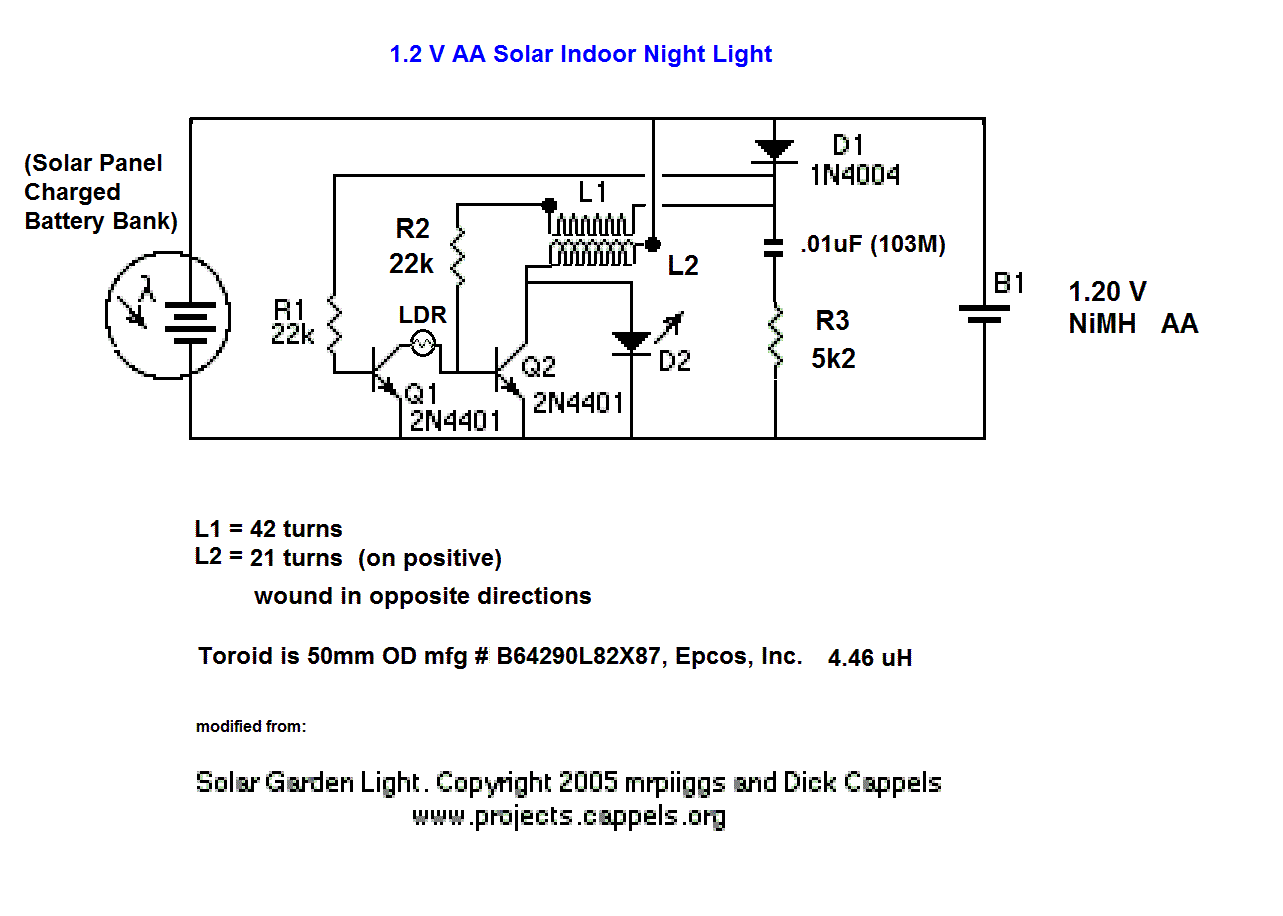
This model uses a simple Joule Thief, BC337 transistors, and I added the LDR and a 100 uF electrolytic capacitor. For indoor use, you can use up to a 3 volt solar panel, as indoor light will not deliver as much voltage as a solar panel would when used outdoors. The LED is a "super bright" 10 mm LED.


Solar Powered Indoor Night Light AA Joule Thief schematic by Dave Hamm


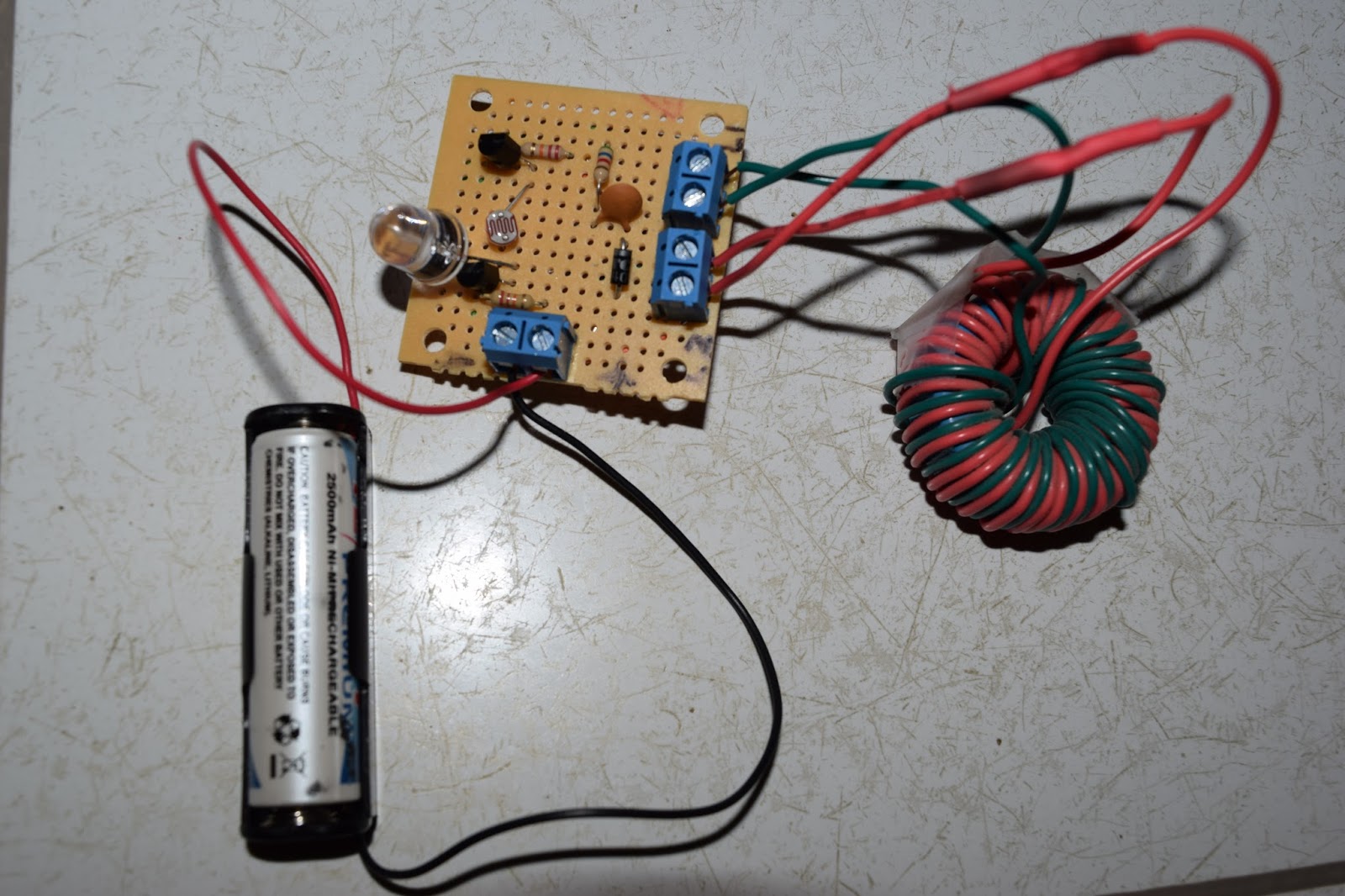
Shown here without the solar panel.

Modified from "Solar Powered Garden Light" by Dick Cappels, (modified from mrpiggs). His arrangement does not use the LDR (Light Detecting Resistor), and used a center tapped transformer. The idea of their model was for outdoor use, and depended upon the solar panel to detect light.


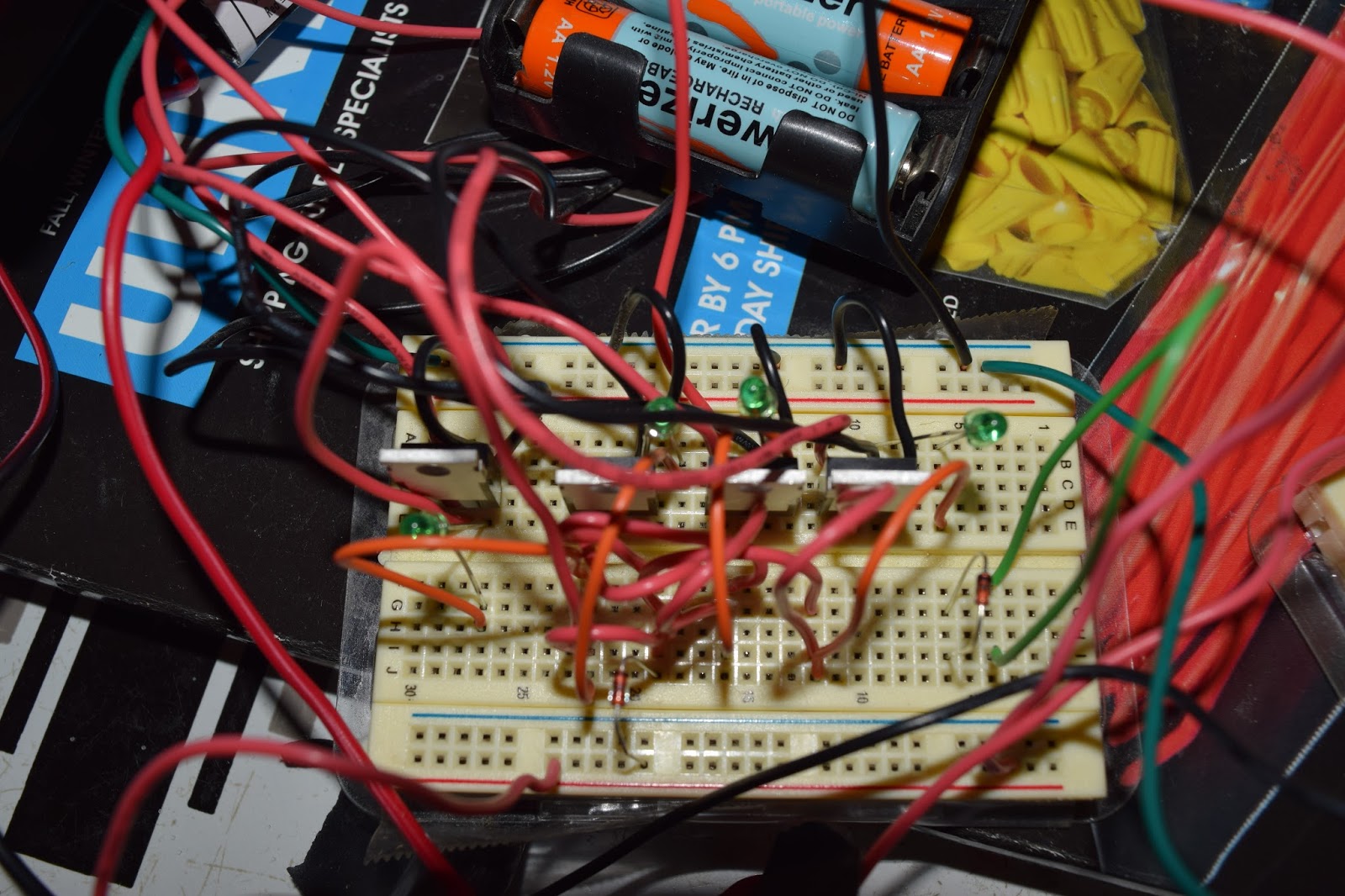
Solar Powered Indoor Night Light AA Joule Thief on a breadboard

I wanted an indoor night light, so I added the LDR to better detect darkness while indoors.


Solar Powered Indoor AA Night Light Circuit Board Layout


Dick Cappels also used 2N4401 transistors, and had no capacitor.
Their model was modified from from a circuit design by Nick Baroni, of Willetton, Washington, and published on the siliconchip.com.au website. Dariusz Flaga in Poland, noted that the BC338 is a good fit for this application.

Reference:

Solar Powered Garden Light
http://cappels.org/dproj/ledpage/leddrv.htm#Solar_Powered_Garden_Light

Circuit design by Nick Baroni, of Willetton, Washington
http://siliconchip.com.au

Monday, September 7, 2015

AA NiMH Ambient Solar Indoor Charger and Night Light

Indoor Ambient Solar AA NiMH Charger & Night Light

  
I had previously worked on an indoor (ambient light) solar charger for 4 AA NiMH batteries, but finally have something that does not quite work well for me. Turns out I have borrowed circuits from at least three other designs, and modified them. The goal was to work for four AA 1.2 volt NiMH 2500 mah batteries indoors under ambient light. After getting it working, I thought it would be good for a long lasting night light when I do not need to charge batteries.

I have seen other circuits for two or three AA batteries, but could not find anything that would charge four in parallel.I wanted to charge in parallel so that the charging would be done evenly, without the need to create a separate battery monitoring circuit.

The circuit also works in direct sunlight, but be warned, the batteries can get warm under direct sunlight. It works well if set near a window that gets at least a couple of hours of sun.
 
Let me see, credits should go to author P. Marian at electroschematics.com (for his 3V boost converter), mrpiiggs and Dick Cappels at cappels.org (for his 1.5 volt Solar Garden Light), and to Afrotechmods video on YouTube (for his Reverse Polarity circuits).

I plan to add a 1.2V AA low voltage indicator, but have not yet decided which circuit will be appropriate for this design.
 
  Main driver circuit for regulated output voltage:

AA NiMH Ambient Light Solar Charger Circuit #1 - The Krell Lab

Modifications included the addition of 547 transistors in an effort to increase the amps, the use of a toroid, and the use of a slightly larger (6V) solar panel.


  The main AA 1.2 volt indoor night light circuit:


AA NiMH Ambient Light Solar Indoor Night Light Circuit #2 - The Krell Lab
The above circuit connects to the charged AA battery bank. Alternatively, it can run from a 1.2 volt AA NiMH battery. I modified this one by using a toroid, using NiMH batteries (in parallel), the addition of a Light Detecting Resistor (LDR), and the use of a capacitor.


For a breadboard view, the overall circuit looks like this:

AA NiMH Ambient Solar Indoor Charger Night Light - The Krell Lab


That's a view from the kitchen table during daylight hours, the window is about 8 feet away. The white Tenergy batteries on the left were used to power the voltage meter only. The charged AA NiMH batteries are near the upper right hand corner.

The volatge regulation circuit is on the bottom left, the night light is on the right, and the polarity check circuit is on the upper left. The batteries are charged in parallel on the upper right.

The above voltage regulation circuit looks like this on the breadboard:
  
 
AA NiMH Ambient Light Solar Charge Regulation Circuit - The Krell Lab


The polarity check part of the circuit is below:

AA NiMH Reverse Polarity check circuit, the batteries are in parallel - The Krell Lab

And a view of the batteries in parallel, being charged from the reverse polarity check circuit:


AA NiMH battery bank of four, the batteries are charged in parallel - The Krell Lab

These are 2500 mah NiMH batteries.

This would be a view of the Night Light on a breadboard:

1.2 volt AA NiMH Night Light on a Breadboard - The Krell Lab

The circuit is able to run an 'Ultra Bright' or 'Super Bright' 10mm LED.
 
 Warning - Do not look directly into an 'Ultra Bright' LED.


And this would be the same night light on a perferated circuit board:

1.2 volt AA NiMH Night Light on a PerfBoard - The Krell Lab
 This version on the perf board has a toroid wound differently, but it still works. I just happened to have this toroid on hand and haven't taken the time to wind another yet.
 
In this picture, I have the windings backwards, as L1 should have the more windings. Just goes to show that it still works when the windings are backwards. However, the LED is not nearly as bright, so if you are not getting a bright light, then check the windings.

I have not tried the ferrite core, as I have no ferrite cores available.

So, there you go. If you want to charge 4 AA NiMH batteries indoors, or just run an indoor night light from rechargeable batteries (or do both), then this should work for you. 

The main problem is I see is regulating the amperage, as in using direct sunlight vs. ambient light. Which is to say, without appropriate amperage, the batteries will not last long under a normal load. So, what is needed next is to test for longevity. I am thinking I may test the number of coil windings and type of coil used (Joule Thief vs. Inductor) for the voltage regulation part of the system. Or, otherwise find a way to increase the current when not in direct sunlight, and keep the default current under direct sunlight.

Update 09/16/2015:

 Using one 6 volt, 1 watt panel, it does not charge properly, and does lose charge over time.
My current thinking is that the main problem is the lack of sustained current (on the order of 250 ma).

Some of the less common parts:


 Warning - Do not look directly into an 'Ultra Bright' LED.

YouTube Video:


                      AA NiMH Ambient Indoor Solar Battery Charger and Night Light
                                                      http://youtu.be/b4epGR1mRyI


Friday, July 3, 2015

Portable Solar Generator In A Battery Box


Portable Solar Generator In A Battery Box


Nothing makes it more clear that you need an off the grid type of system than when a hurricane hits and knocks your electricity out for a week. Even up here in Ohio, hurricane Ike hit us with winds that left us without power. But, I have also lived in Michigan, where we lost power more often than we lose it here in Ohio. And a portable system lets you use that power in other situations, such as camping or boating. More than that though, it's just fun to generate your own free electricity without feeling dependent upon your local power company.

I have read a number of newspaper stories about seniors who have died in extreme heat or extreme cold, so living without power even for a short time can be life threatening for some.

This post is intended to help you build your own portable solar generator. For this prototype, a battery box was used.

Meter Layout


Portable Solar Generator In A Battery Box - Meter Layout - The Krell Lab

Wiring Schematic

A general schematic of the wiring:

 
Portable Solar Generator In A Battery Box - Wiring Schematic - The Krell Lab


Videos

  Portable Solar Generator In A Battery Box Part 1    - The Layout
        
 Portable Solar Generator In A Battery Box Part 2  - Getting beyond the layout:
  
 Portable Solar Generator in a Battery Box Part 3 - Wiring the layout:

 Portable Solar Generator in a Battery Box Part 4 - Meters & Switches

 Portable Solar Generator in a Battery Box Part 5 - Final Layout & Solar Tracker

 Portable Solar Generator in a Battery Box Part 6 - The Solar Tracker Problem & Trouble-Shooting It
 
   
 Portable Solar Generator in a Battery Box Part 7 - Solar Tracking Problem Resolved
 
Wagan Wattage Guide

 Wagan includes this handy wattage guide with the 400 watt pure sine wave inverter:

Wagan Wattage Guide


Parts List


  I was able to get the box on sale for $9.00, so shop around.
   

  Wagan EL2601 Elite 400W Pro Pure Sine Wave.................$199.95
  
 I was able to get the inverter on sale for $119, so it may help to shop around.


 This controller would be for my sealed lead acid batteries. You can get one cheaper without the display.


  Batteries

   PowerStream HR22-12 ...........................................................$ 67.10

   However, a LiPO4 batteries twice as powerful could be used in this space.
   If you use a lithium battery, be sure to also use a lithium controller.
   Also, be careful to insulate the battery from the heat of inverter.

   I have used the Lithium Battery and Lithium Charge Controller in my portable solar generator in a File Folder box.


Blue Sea Systems Dual USB Charger Socket ...........................$ 25.98

  I was able to get this USB socket on sale for $ 16.77

Cigarette lighter fuse/circuit breaker.............................................. $  4.87


Waterproof LED Rocker Toggle Switch SPST Marine .......... $9.99 + $4.49 shipping

Battery Cut-off Switch ....................................................................$ 20.00

   I was able to get the cut-off switch on sale for $8.00
  

 Lighted power switch Cherry SWITCH ROCKER SPST 20A 125V ..............$1.30

 35 Amp Circuit Breaker Digi-Key Part NumberPB1049-ND ..........................$4.55

 Circuit Breaker 15 Amp 1/4" Terminals .........................................................$4.89
 
 Circuit Breaker Switch 20A 125VAC 50VDC .................................................$3.54


Links:
 

Wednesday, June 3, 2015

Portable Solar Tracking Mount


Portable Solar Tracking Mount


Folks have been building portable solar power generators for emergencies, camping trips, and boating. I have always noticed that most just find a place in the sun, and set the unit there. Few, if any had any solar tracking mount for their unit.

I bought a portable solar power generator unit, and got tired of positioning the portable solar panel, so I wanted to build a portable solar tracking mount for it. I also wanted to build a better unit on my own, or maybe two. We had a power outage for a week a couple of years back, and were without power for a week. I think it was hurricane Ike, winds hitting us way up here in Ohio.

I wanted a sturdy mount that would not fall over easily in the wind. On this day, it was windy, but nothing very fierce. It was also partly cloudy, and when the clouds cover the sun, the tracker circuit will wait for about 10 seconds for the clouds to pass, then if the clouds remain, it will search for the brightest spot in the sky. Therefore, there are a couple of times in the video where the mount appears to move back and forth briefly.


The tracking unit can be programmed to reset at night, but I do not plan to leave it out at night, so I have not set that.

Here, I am testing with 10 AA batteries (12 volts) just to look for problems. After I am happy with it, it will simply plug it into my portable solar generator.
I hope to do a video later showing "How To' build it.
 
Here, the mount is single axis, but I am thinking it could become a dual axis by replacing the vertical support with a very small actuator (or just strap another servo to the vertical axis). Not to forget, the tracking circuit requires a limit switch if you use an actuator.


General Design


Close-Up

 
Portable Solar Panel Mount motor side view - Krell Lab


Portable Solar Panel Mount back view - Krell Lab

Portable Solar Panel Mount base side view - Krell Lab

 Time Lapse Video

http://www.youtube.com/watch?v=AybYJrLvMlY


See also the story at the ServoCity blog:


   Building a Portable Solar Tracking Mount


Some of the parts used for the mount:
-------------------------------------------------------- 
Tripod

MCMElectronics.com

Adjustable Speaker Stand 80lb Capacity    $ 27.59
http://www.mcmelectronics.com/product/555-11650

1 3/8'' Speaker Pole Mount Adapter         $1.89
http://www.mcmelectronics.com/product/555-13807?green=83A9FD1C-3EE1-5B3F-0696-2518B229448E


What I like about the stand is that it should hold up to winds, and it telescopes to 7 feet.
In the winter, the area within the time lapse video is in a shaded area, and raising the mount to 7 feet will enable it to capture the sun during the winter months. It will support up to 80 pounds, is lightweight (7 pounds), and can be carried with or without the carrying case.

-------------------------------------------------------- 
Solar Panel

RENOGY® 30 Watt 30w Monocrystalline Photovoltaic PV Solar Panel UL Listed Module 12v     $64.99
13.5x23.8x1 inches - mine is larger...464mm (18.27") x 556mm (21.9") x 35mm (1.38"), It puts out 1.8 amps
http://www.amazon.com/gp/product/B00JDRG69K?ie=UTF8&tag=reviewazon0a-20
http://www.renogy-store.com/Renogy-30W-12V-Mono-Solar-Panel-p/rng-30d.htm
  

Currently unavailable.
I don't know when or if this item will be back in stock.
-------------------------------------------------------- 
Tracking circuit

Amazon

SBE Solar Tech 12V Digital Solar Tracker Control Board MK3.1  ......$39.00 + $4.62 shipping by SBESolarTech


http://www.amazon.com/Solar-Digital-Tracker-Control-Board/dp/B00HXWTAWM/ref=pd_bxgy_lg_text_y

SBE Solar Tech Sun Tracker Weather Enclosure  ......................$14.99 + $4.62 shipping
by SBESolarTech


http://www.amazon.com/Solar-Tech-Tracker-Weather-Enclosure/dp/B00HXXK97G/ref=pd_bxgy_lg_text_y
 

 If you use a larger panel, or different servo, you may need to add the tracker relay circuit:

  http://www.amazon.com/Solar-Tracker-Booster-Module-Enclosure/dp/B00LZ207SC/ref=pd_sim_86_3/175-8030547-3545713?ie=UTF8&refRID=03QBS19R3BMQBQY9DB38

----------------------------------------
Support Beams (that attaches to panel):


Menard's or Ace Hardware

http://www.menards.com

Plated Slotted Steel Angle 14 Guage 1-1/2" x 2 foot  $ 5.79 each
-------------------------------------------------------- 
Motor, base, & rotating mechanism
ServoCity
http://www.servocity.com/

(8871T31) 1/4 inch Bore Clamping Motor Mount             $ 1.99
(638154) 2 RPM Gear Motor (RZ12-1500-2RPM)               $24.99
       * Weight: 0.27 lbs. each
(9753K65) Gearmotor End Cap                              $ 0.89
or
(9753K66) Precision Gearmotor End Cap                    $ 0.99
(615206) 80T, 32P, 1/2 inch Bore Aluminum Gear           $12.99
(615270) 32 Tooth, 32 Pitch, 6mm Bore Pinion Gear        $12.99
(585438) Round Base A                                    $ 6.99
(585440) 1.50 inch Aluminum Channel                      $ 2.99
(635256) 6 inch length x 1/2 inch dia. Aluminum Tubing   $ 2.69
(633110) 1/2 inch Shafting & Tubing Spacers (12 pk)      $ 1.69

  
Plus miscellaneous parts: beams, screws, washers, nuts, etc.
I will try to get the "How To" build it video out later with instructions

Thursday, May 28, 2015

How To Build an MPPT Solar Charge Controller with Arduino


How To Build an MPPT Solar Charge Controller with Arduino

Julian Ilett has a series of 20 YouTube videos that show you how he built an MPPT solar charge controller with Arduino. Maximum Power Point Tracking (MPPT) is electronic tracking that enables the charge controller to compare the output of the panels to the battery voltage. It then figures out what is the best power that the panel can put out to charge the battery.

What that usually means that it tries to increase the charge on cloudy days (or in the mornings if your panel is not pointed to the sun) so that you can get the most from your panels.


Arduino MPPT Solar Charge Controller by Julian Ilett


 What is nice about this one is that he walks you through "How To" build the graphic display.

MPPT Solar Charger Graphic Display by Julian Ilett


There are 20 videos in Julian's video series, and they start here:


MPPT Solar Charge Controller #1 - Introduction and Voltage Measurement

http://www.youtube.com/watch?v=MSz4-cr3EJw&list=PLjzGSu1yGFjWv4KeN-7TSYeQIcicM9Ghl

At video #14, he changes the name of the series:

Arduino MPPT Solar Charge Controller #14 - Stable Current Measurements 

 http://www.youtube.com/watch?v=PqKOyRdB2RU&index=14&list=PLjzGSu1yGFjWv4KeN-7TSYeQIcicM9Ghl

 And, if you would like to see where he ended with the videos on this topic, here is #20:

Arduino MPPT Solar Charge Controller #20 - Inductor Discontinuous Mode

http://www.youtube.com/watch?v=k9UFrCIVp0Y&list=PLjzGSu1yGFjWv4KeN-7TSYeQIcicM9Ghl&index=20


California Nonprofit Offers Free Solar Panels to Its Poorest


California Nonprofit Offers Free Solar Panels to Its Poorest


Photo: Michael Macor, The Chronicle via SFGate Magazine


A new California program by the Oakland nonprofit Grid Alternatives will install home solar arrays in disadvantaged neighborhoods and aims to make solar power available to lower-income families — using money from the state’s fight against global warming. 

Full story by David R. Baker at SFGate Magazine:

  
  http://www.sfgate.com/business/article/Low-income-homeowners-get-free-solar-panels-6281762.php


Wind Turbines With No Blades


Wind Turbines With No Blades

A prototype of the Vortex Bladeless wind turbine from Wired Magazine 


"A Spanish company called Vortex Bladeless is proposing a radical new way to generate wind energy that will once again upend what you see outside your car window."

If you happen to see one of these, and are wondering what the heck it is....

Full story at:


http://www.wired.com/2015/05/future-wind-turbines-no-blades/


How To Build a Solar Cabin For Under $2000


How To Build a Solar Cabin For Under $2000


Nice video by Lamar Alexander, includes links to plans.

It is a 14' x 14' cabin with loft, providing about 400 square feet.
Power system is 580 watts Solar electric and 400 Watts wind power which powers a 12 volt fridge, lights, water pump, TV's, laptop and many gadgets. 
Heat source can be propane or wood stove. 
Toilet is solar assisted composting.


Wednesday, May 13, 2015

How to Build the SolN1 Portable Solar Generator for Safety


How to Build the SolN1 Portable Solar Generator for Safety

LaserSaber came up with the idea of a light-weight mobile solar power generator with his video on YouTube.


However, the original SolN1 is missing the controller, and that controller should be compatible with LiFePO4 batteries...

Also, if you use the flat LiFePO4 batteries, you really need a Protection Circuit Module (PCM) for charging the four (flat) LiFePO4 batteries.


Here's a video from John Strabismus where he has the LiFePO4 controller and PCM:


The charge controller is needed so that you do not overcharge the battery. If you overcharge the battery, the LiFePO4 batteries tend to swell up, and can emit some dangerous fumes. In the worst case, they can even catch fire.
 
The battery management system is required because combining batteries for total power can cause a discharge at different rates per battery. This can cause problems when charging, leaving some of the battery pack undercharged, and others overcharged.

Regarding sizing of the PCM module, John Strabismus says:


"The main thing to keep in mind with your PCM choice is the size of the inverter you will be running. LaserSaber chose a 150w inverter, fully loaded it will pull close to 15amps continuous and surge a bit higher, that's why the surge rating on the PCM is higher than needed, as the inverter starts up with load it will pull more amps briefly then settle to its load draw, so the 16amp PCM matches the 150watt inverter, if you go higher like a 200 watt inverter you will be over the 16amps draw fully loaded and this will more than likely cause the PCM to shut down the load , so using a 20amp PCM for a 200watt inverter will match the components better."

So, you should remember that the PCM chosen should be based upon the power of the inverter.

You can find the PCM circuit boards on BatterySpace.com:

------------------------------------  
  - PCM for a 150 Watt inverter:
------------------------------------  
Protection Circuit Module (PCM) for 4 cells (12.8V) LiFePO4 Battery Pack at 16A limited  
Part Number: PCM-LFP12.8V16A

http://www.batteryspace.com/pcmprotectioncircuitmodulefor4cells128vlifepo4batterypackat16alimited.aspx


-------------------------------   
PCM for a 200 Watt inverter:
-------------------------------
Protection Circuit Module (PCM) for 4 cells (12.8V) LiFePO4 Battery Pack at 20A limited
Part Number: PCB-LFP12V25A


http://www.batteryspace.com/PCB-for-4-cells-12.8V-LiFePO4-Battery-Pack-at-20A-limited.aspx


or


Part Number: PCB-LFP12.8V20A
http://www.batteryspace.com/pcbprotectioncircuitmodulefor4cells128vlifepo4batterypackat20alimited.aspx

   ------------------------------------------  

The "Flat" type of LiFePO4 batteries can be found on AliExpress:
 

3.2V 20Ah A123 LiFePO4 Prismatic APP72161227 PHEV/EV/E-REV Rechargeable Battery      $33.88 each x 4
http://www.aliexpress.com/w/wholesale-a123-prismatic-lifepo4-20ah.html

3.2V 5C   20Ah
Nominal Voltage:    1.2V
Nominal Capacity:    20Ah
Size:    7x166x227mm       (.276" x 6.54" x 8.94")
Package Size:    10cm x 10cm x 5cm (3.94in x 3.94in x 1.97in)
Cell Weight:    About 496 g   (1.09 pounds ea.)
Cell Capacity (minimum, Ah):    19.6A
Charge voltage:    3.75V
Power:    Over 2,400 W/kg and 4,500 W/L
Continuous discharge rate:    5C 100A
Peak discharge rate:    20C 400A (10 seconds) 


The original SolN1 videos:

 DIY Build Session SOLN1 Portable Solar Power:
https://www.youtube.com/watch?v=7CUuqJDzo1U

 SOLN1 - Amazing all in one free energy portable solar unit:
https://www.youtube.com/watch?feature=player_embedded&v=hy9wT7Vvkdw


DIY Build Session SOLN1 Portable Solar Power
https://www.youtube.com/watch?v=7CUuqJDzo1U

SOLN1 - Amazing all in one free energy portable solar unit.
https://www.youtube.com/watch?v=hy9wT7Vvkdw


Real Time SOLN1 Making-of + Other Updates
https://www.youtube.com/watch?v=x2XwmnjnwH0

SOLN1 Version 3 - Solar made easy!
https://www.youtube.com/watch?v=7-Y5TvWpWoQ


SOLN1 Update - Testing the Mini Boostpack
https://www.youtube.com/watch?v=z0a-2Zcy-VI


Battery Free Solar! Real Time Solar - Nano BoostPack + SOLN1
https://www.youtube.com/watch?v=_io9YHKdbTw


SOLN1 25 Kit Build Video - 20Ah Version
https://www.youtube.com/watch?v=MUUwnMwRlTk

Sunday, December 14, 2014

Super Simple Temperature(Heat) Activated LED/Cooling Fan Circuit (NC or NO??)

           Super Simple Temperature(Heat) Activated LED/Cooling Fan Circuit 

                                    (Normally Open or Normally Closed??)


I was looking for a simple temperature controlled cooling fan circuit for my prototype inverter, and was excited to run across one on YouTube from electronicsNmore called "Super Simple Temperature(Heat) Activated LED/Cooling Fan Circuit."

Great! Simple! 

Just like what I was looking for.

Super Simple Temperature(Heat) Activated LED/Cooling Fan Circuit from electronicNmore


So, I ordered some 45 degrees C (113 degrees Fahrenheit) bimetal temperature sensors that I found on Amazon "High Quality KSD9700 250V Bimetal 45 Celsius NC Temperature Control Switch Pack Of 10." 

The parts arrived promptly from China via U.S. Post Office, so I immediately set about getting the circuit up and running on a breadboard. 

However, it did not work! I was very puzzled - this is a very simple circuit to build.

I checked the video comments again. Sure enough, he said "Normally Closed" sensor.
  
  
Normally Closed sensor for Super Simple Temperature Activated Cooling Fan Circuit


So, I thought I would do a simple test to see if the sensor was really "NC" (Normally Closed), or perhaps the vendors sent "NO" (Normally Open) by mistake. A direct connect of positive to negative and directly to the fan should tell me. If the sensor is Normally Closed, then the fan should com on without the breadboard set up. 

The fan did not come on. It would appear that the vendor sent Normally Open temperature sensors instead of Normally Closed sensors! 

So, I had the wrong temperature sensors for this circuit. Let me see, my options were that I could send the sensors back to the vendor, but I got these fairly cheap, and the postage would just add to the cost. Or, I could look for a "NO" version of the YouTube circuit. I thought i would be easy.... wrong thought. 

I searched YouTube for a "Normally Open" version of the cooling fan circuit only to be disappointed. One blog said just buy the "NC" version if you have an "NC" circuit. Well, I already did that. How many times would this part problem happen?? So, I spent a few more hours on Google looking for a "Normally Open" version of this simple circuit without finding one.

After hours of searching, I was at a loss. I took electromagnetic theory in college, but other than that, I have no electronics training. So, writing up my own circuit is not something that I normally attempt. Then I remembered a comment from Mr. Swagatam Majumdar on his "Low Battery Indicator" circuit. You could reverse the polarity of the circuit in order to convert it to a "High (Overcharge) Indicator" circuit.


Converting a Low Battery Indicator into a High (Overcharge) Battery Indicator


Maybe I could turn the super simple temperature controlled (Normally Closed) circuit into a Normally Open circuit.

So, I gave it a shot. I reversed the positive and negative on the cooling fan circuit, changed the polarity of he transistors, and reversed the diode polarity.


And it worked!

Super Simple Temperature(Heat) Activated LED/Cooling Fan Circuit Normally Open

I am thrilled. Now I have a simple temperature controlled cooling fan circuit no matter if I have NC or NO type sensors. Excellent.

Ideally, if the circuit fails, you would want your cooling fan to be able to come on at start-up by default. That will be one of the things that I will test for. My guess is that the "Normally Open" sensor will not fail over when the sensor fails, but might fail over if I lose a transistor.

I have not checked yet, but you probably do not need a circuit for the "NO" sensor. I am thinking that it should work with a direct connect. But, it is good to know that electronicsNmore also provides an indicator circuit in his video, and the circuit can be used for whatever your needs may be.

Thank you to electronicsNmore on YouTube, and to Swagatam Majumdar at Homemade Circuit Just For You.


Video from electronicsNmore:


Amazon "High Quality KSD9700 250V Bimetal 45 Celsius NC Temperature Control Switch Pack Of 10." 

Amazon "10 Pcs Bimetal Temperature Control Switch Thermostat 40C N.O TLRS9700"
." 
YouTube video link:

Super Simple Temperature(Heat) Activated LED/Cooling Fan Circuit

Update 12/16/2014:   

O.K., new thought there. I am thinking I can use his circuit with a slightly higher temperature for a automatic shutdown to prevent overheating. Maybe place it downstream of the "On" LED (part of the inrush protection circuit), and downstream of the fan so that the fan keeps cooling after the circuit shuts down. He also has an indicator light circuit in this video that I can use when the shutdown kicks in. Great. Don't want to start a fire or ruin the parts....